IQ is one of the most recognized ways to describe cognitive ability, but the number itself is often misunderstood. A good IQ test does not define your value as a person. It gives an estimate of how you solve problems, recognize patterns, process information, and use logical reasoning.
In this article, we explain what IQ means, how intelligence tests appeared, what modern IQ tests usually measure, how to interpret a score, and why knowing your intelligence level can be useful for learning and personal development.
What Is IQ?
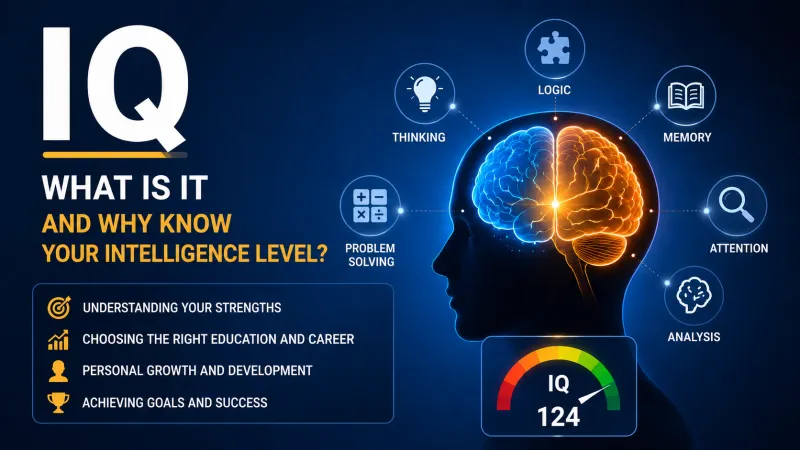
IQ stands for Intelligence Quotient. It is a numerical estimate used to compare a person's cognitive performance with a statistical average.
In simple terms, IQ reflects how well a person can:
- analyze information;
- identify patterns;
- think logically;
- learn quickly;
- solve problems;
- perceive and process new information.
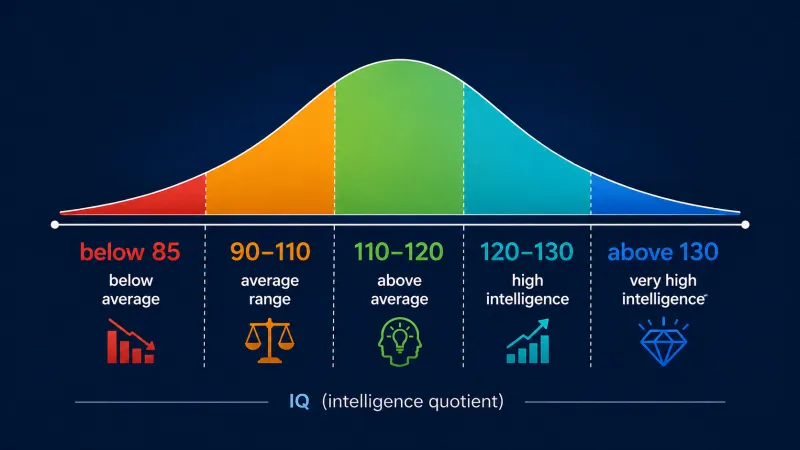
For most people, an IQ score falls around the 90-110 range. Scores above that range usually suggest stronger analytical or problem-solving skills, while very high results may indicate exceptional reasoning ability.
How Did IQ Tests Appear?
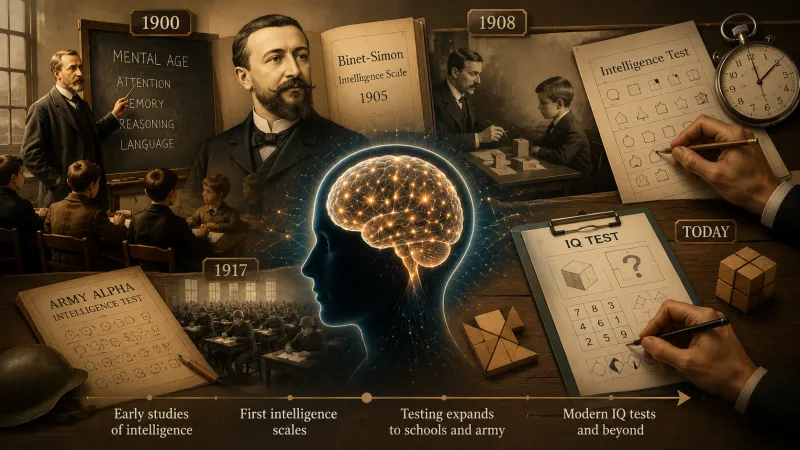
The history of intelligence testing began in the early 20th century. French psychologists Alfred Binet and Theodore Simon created one of the first practical systems for identifying children who needed additional learning support.
Later, the idea was expanded and adapted for education, psychology, research, and workplace assessment. Today, IQ tests are used worldwide as one tool for estimating cognitive abilities.
What Do IQ Tests Measure?
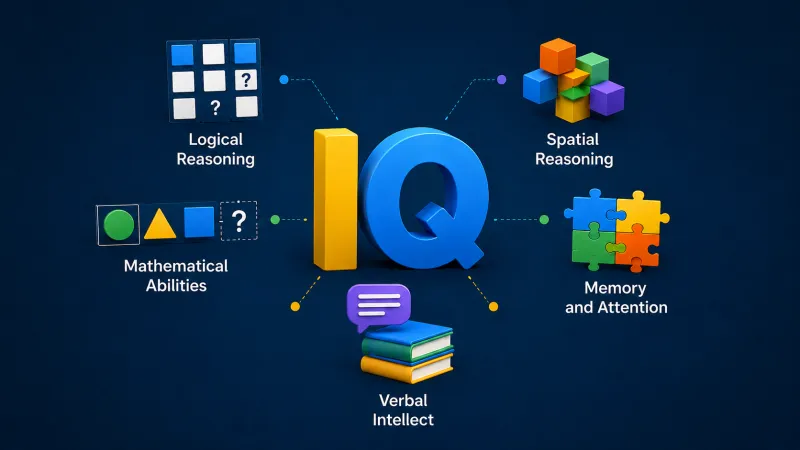
Modern IQ tests can include several types of tasks. The exact structure depends on the test, but the most common areas are:
Logical Thinking
These tasks ask you to find rules, patterns, sequences, and relationships between objects.
Mathematical Reasoning
Some tests check how confidently you work with numbers, calculations, and abstract logical operations.
Spatial Thinking
Spatial tasks involve rotating shapes mentally, comparing figures, and understanding how objects change in space.
Memory and Attention
Certain tests evaluate how quickly you remember, focus on, and process new information.
Verbal Intelligence
Verbal tasks measure understanding of words, meanings, analogies, and language patterns.
What Does an IQ Score Mean?
An IQ score should be read as an estimate, not as a fixed label. It does not make one person better or worse than another. It simply describes one part of cognitive performance.
- Below 85 - below average;
- 90-110 - average range;
- 110-120 - above average;
- 120-130 - high level;
- Above 130 - very high level.
A high IQ does not guarantee success, and an average score does not prevent a person from achieving strong results. Motivation, discipline, emotional intelligence, communication, creativity, and environment also matter.
What Determines IQ?
Researchers usually describe intelligence as the result of several factors working together.
Genetics
Heredity can influence cognitive potential, but it is not the only factor.
Education and Environment
Thinking develops through learning, reading, communication, problem solving, and exposure to intellectual challenges.
Lifestyle
Sleep, nutrition, physical activity, and stress levels all affect how the brain performs.
Continuous Development
The brain remains adaptable throughout life. Reading, learning languages, solving tasks, and training memory can help maintain cognitive performance.

Can You Increase IQ?
Scientists continue to debate whether IQ itself can be significantly increased. However, most experts agree that people can improve the skills that affect test performance and everyday thinking.
You can develop:
- thinking speed;
- memory;
- concentration;
- analytical skills;
- learning ability.
Useful habits include regular reading, logic games, learning new skills, physical activity, enough sleep, and consistent brain training.

Why Do People Want to Know Their IQ?
People take IQ tests for different reasons. Some are simply curious. Others want a starting point for self-development or want to understand which types of tasks feel easier for them.
- Self-knowledge: understanding your strengths and thinking style.
- Curiosity: IQ tests have become part of popular culture.
- Strength assessment: results can show where your reasoning is strongest.
- Development: a test can become a starting point for training memory and logic.

Common Myths About IQ
Myth: IQ Determines Success
Success depends on many factors, including discipline, emotional intelligence, motivation, social skills, and persistence.
Myth: IQ Never Changes
Basic abilities can be partly inherited, but the brain remains flexible. Skills connected with attention, memory, logic, and learning can improve.
Myth: Only Geniuses Have a High IQ
Above-average scores are more common than many people think. A high score is meaningful, but it is not the only sign of talent or potential.

Interesting Facts About IQ
- Average IQ scores can differ between populations because of education, living conditions, health, and test access.
- The exact IQ scores of many historical figures remain debated.
- The Flynn effect describes the long-term rise in average IQ scores observed in many countries during the 20th century.
- Some employers use logic tests that resemble IQ tasks during hiring.

Is an IQ Test Worth Taking?
Yes, if you treat it correctly: as a way to learn more about your thinking and train your brain, not as a final judgment about your personality or future.
An IQ score does not define your talent, kindness, creativity, or ability to be happy. But it can give useful insight into how your mind works.
If you want to estimate your current level, you can take a free online IQ test and compare your result with statistical benchmarks.